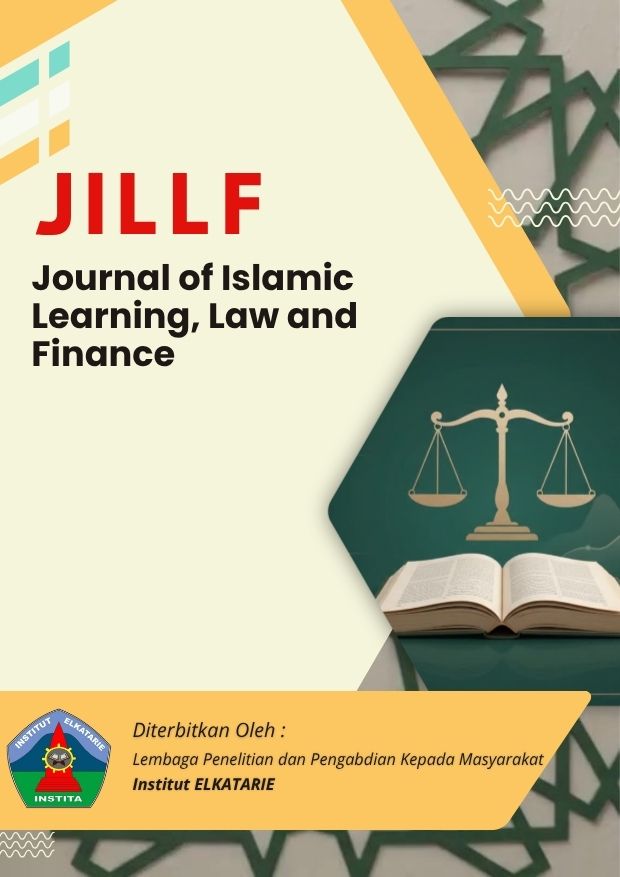
About the Journal

Journal Title : Journal of Islamic Learning, Law and Finance (JILLF)
Initial : JILLF
Language : Indonesia and English
e-ISSN : xxxx-xxxx
DOI : https://doi.org/10.55681/elkatarie by  
Publisher : LPPM Institut Elkatarie
Editor-in-chief : Ishep Tahta Maulana
Email : JILLF@elkatarie.ac.id
Citation Analysis : Sinta | Google Scholar  Garuda
Journal of Islamic Learning, Law and Finance (JILLF) is a peer-reviewed, open-access international journal dedicated to publishing pioneering research at the tripartite intersection of Islamic educational systems, jurisprudential methodology (Fiqh and Usul al-Fiqh), and modern Sharia-compliant financial dynamics. Positioned as a premier multidisciplinary Islamic studies scholarly forum, the journal serves academic scholars, legal theorists, Islamic educationalists, Sharia advisers, financial economists, and public policy analysts worldwide. JILLF prioritizes rigorous empirical research, doctrinal legal analyses, conceptual pedagogical frameworks, and qualitative field studies that evaluate how Islamic learning institutions foster intellectual development, how jurisprudential rulings adapt to contemporary legal challenges, and how ethical Islamic financial mechanisms drive sustainable economic growth. By synthesizing Islamic pedagogy, jurisprudence, and economic execution, the journal fosters a deep, comprehensive understanding of how integrated Islamic frameworks address modern socio-legal and financial complexities.

Scope and Topics
Reflecting its mandate to examine the interconnected pillars of Islamic education, law, and financial governance, the journal welcomes high-quality original research articles, systematic literature reviews, comparative legal analyses, and empirical studies within the following thematic areas:

Islamic Learning, Pedagogy & Institutional Governance: Modernization of Islamic educational curricula, higher education administration in the Muslim world, character development (Tarbiyah), digital Islamic learning technologies, and classical Islamic intellectual history.

Islamic Law, Jurisprudence & Sharia Governance: Contemporary application of Fiqh and Usul al-Fiqh, legal maxims (Qawa'id Fiqhiyyah), comparative legal systems, human rights in Islamic law, constitutionalism, and Fatwa methodology in modern contexts.

Islamic Banking, Capital Markets & Financial Contracts: Mechanics of Sharia-compliant banking, Sukuk structures, Takaful governance, Islamic capital market instruments, financial risk mitigation, and legal documentation of Muamalat.

Social Finance, Philanthropy & Wealth Management: Institutional management and optimization of Zakat, Infaq, Sadaqah, and Waqf (cash and asset endowments), microfinance, poverty alleviation models, and social impact investment.

Ethical Economy, Halal Markets & FinTech Innovations: Regulatory frameworks for the global Halal industry, corporate governance, consumer protection, blockchain applications in Waqf/Zakat, and AI ethics within Islamic financial law.

Publication Frequency
To ensure rigorous editorial oversight, thorough peer review, and the timely dissemination of multidisciplinary Islamic research, JILLF is published semi-annually (2 issues per year, typically scheduled for release in June and December). Special thematic issues focusing on legal and financial adaptations to digital economies, modern Waqf management strategies, or comparative Islamic jurisprudence may be commissioned by the Editorial Board.

Peer Review Process
JILLF enforces a strict double-blind peer review policy to maintain the highest standards of academic integrity, legal/doctrinal precision, and methodological validity across Islamic studies, law, and economics disciplines.

Initial Desk Evaluation: Every submission undergoes a preliminary screening by the Editor-in-Chief or a relevant Subject Editor to assess thematic alignment, methodological soundness (doctrinal legal rigor, qualitative/quantitative research design, textual analysis depth, or empirical validity), and structural compliance. Plagiarism screening via Turnitin/iThenticate is strictly executed at this stage, requiring a similarity index below the journal's maximum threshold.

Expert Peer Review: Manuscripts passing the desk evaluation are anonymized and assigned to at least two independent international reviewers who are established academic experts, Islamic jurists, or senior financial specialists in the relevant domain.

Editorial Decision: Based on the reviewers' recommendations, the Editorial Board renders one of four decisions: Acceptance, Revisions Required (Minor/Major), Resubmit for Review, or Rejection. The final decision rests entirely on intellectual merit, theoretical/doctrinal rigor, analytical clarity, and potential societal or policy impact.

Mission Statement

The mission of the Journal of Islamic Learning, Law and Finance (JILLF) is to bridge educational, legal, and economic scholarship to foster ethical, transparent, and resilient societal institutions grounded in Islamic principles. Grounded in the philosophy that sustainable human and economic development requires a harmonious balance of sound education, just legal governance, and ethical financial practices, the journal aims to democratize advanced research by providing an unrestricted platform for global academic, judicial, and financial dialogue. Through the promotion of diverse, rigorous qualitative, quantitative, doctrinal, and comparative methodologies, JILLF seeks to empower educational leaders, inspire legal scholars, and shape future-proof Islamic legal and financial paradigms worldwide.

Journal of Islamic Learning, Law and Finance (JILLF) is indexed and/or available catalogue in: