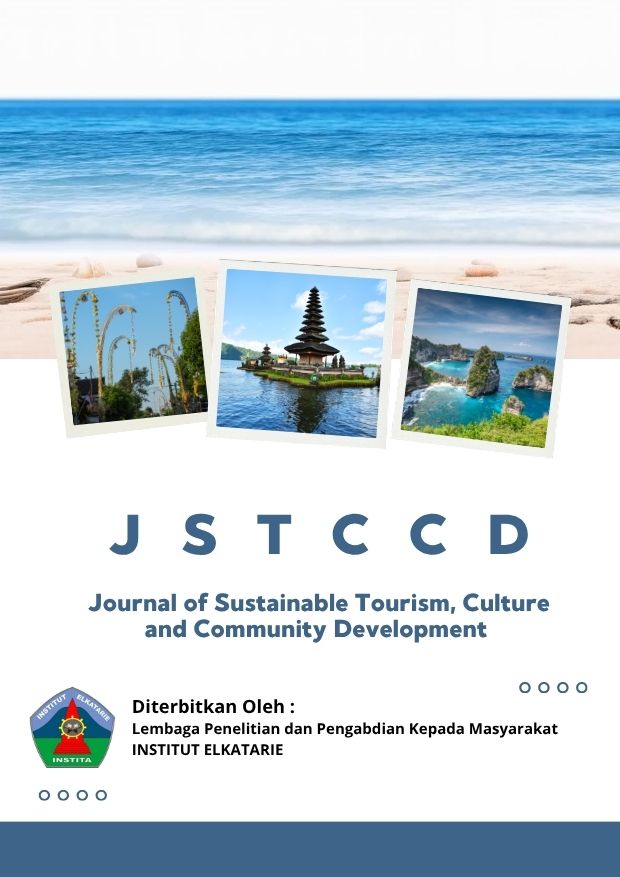
About the Journal

   Journal title  : JSTCCD: Journal of Sustainable Tourism, Culture and Community Development
   Initials  : JSTCCD
   Abbreviation  : JSTCCD J. Sustain. Tour. Cult. Community Dev.
   Frequency  : 2 issues per year
   DOI  : https://doi.org/10.55681/aspirasidigital by Crossref
   Online ISSN  : xxxx-xxxx
   Editor-in-Chief  : Ishep Tahta Maulana
   Publisher  : LPPM Institut Elkatarie
   Citation Analysis  : [Sinta] [Google Scholar]

JSTCCD: Journal of Sustainable Tourism, Culture and Community Development is a peer-reviewed, open-access international journal dedicated to publishing pioneering research at the vital intersection of the hospitality industry, cultural heritage preservation, and socio-economic empowerment. Positioned as a premier multidisciplinary scholarly forum, the journal serves tourism scholars, cultural anthropologists, urban and regional planners, environmentalists, and policymakers worldwide. JSTCCD prioritizes macro-level destination evaluations, rigorous empirical field research, and innovative policy frameworks that address the complexities of mass tourism, environmental degradation, and the socio-cultural impacts on local populations. By bridging sustainable tourism theories with actionable community-based models, the journal fosters a deep, comprehensive understanding of how travel and tourism can act as catalysts for ecological conservation, cultural revitalization, and inclusive economic growth in a rapidly globalizing world.

Scope and Topics

The journal welcomes high-quality original research articles, critical literature reviews, and empirical case studies that offer significant contributions to the following thematic areas:

  • Sustainable & Eco-Tourism: Environmental conservation in tourism, carrying capacity, green hospitality management, climate change adaptation in travel, and nature-based tourism dynamics.

  • Cultural & Heritage Tourism: Preservation of tangible and intangible cultural heritage, indigenous tourism, the sociology of tourism, authenticity vs. cultural commodification, and creative/arts tourism.

  • Community-Based Tourism (CBT) & Empowerment: Socio-economic impacts of tourism, poverty alleviation through local enterprise, rural and agritourism, and frameworks for active local community participation and profit-sharing.

  • Destination Planning, Policy, and Management: Tourism governance, crisis management and post-disaster recovery, sustainable destination marketing, and the alignment of tourism policies with the UN Sustainable Development Goals (SDGs).

  • Technology & Innovation in Tourism: Smart tourism destinations, digital preservation of cultural heritage, the impact of the sharing economy (e.g., Airbnb), and the use of big data and GIS in destination planning.

Publication Frequency

To ensure rigorous editorial oversight, thorough peer review, and timely dissemination of critical tourism and developmental research, JSTCCD is published semi-annually (2 issues per year, typically scheduled for release in June and December). Special thematic issues focusing on urgent challenges like post-crisis tourism recovery, climate change disruptions, or disruptive technological shifts in heritage conservation may be commissioned by the Editorial Board.

Peer Review Process

JSTCCD enforces a strict double-blind peer review policy to maintain the highest standards of academic integrity, analytical objectivity, and empirical validity.

  • Initial Desk Evaluation: Every submission undergoes a preliminary screening by the Editor-in-Chief or a relevant Subject Editor to assess thematic alignment, methodological soundness (qualitative, quantitative, or mixed-methods), and structural compliance. Plagiarism screening via Turnitin/iThenticate is strictly executed at this stage, requiring a similarity index below the journal's maximum threshold.

  • Expert Peer Review: Manuscripts passing the desk evaluation are anonymized and assigned to at least two independent international reviewers who are established academic experts or senior practitioners in the specific domain of tourism, cultural studies, or development.

  • Editorial Decision: Based on the reviewers' recommendations, the Editorial Board renders one of four decisions: Acceptance, Revisions Required (Minor/Major), Resubmit for Review, or Rejection. The final decision rests entirely on the intellectual merit, theoretical rigor, and practical applicability of the work to sustainable developmental goals.

Mission Statement: "The mission of JSTCCD is to deconstruct the extractive models of traditional tourism and catalyze transformative, equitable, and sustainable travel practices within a rapidly evolving global society. Grounded in the philosophy that responsible tourism, profound respect for cultural diversity, and inclusive community empowerment are the absolute anchors for sustainable global development, the journal aims to democratize advanced knowledge by providing an unrestricted, high-impact platform for cross-disciplinary scholarly dialogue. Through the promotion of diverse and rigorous methodological approaches—encompassing ethnographic fieldwork, spatial tourism planning, and quantitative socio-economic assessments—JSTCCD seeks to empower local communities, inspire tourism innovators, and shape future-proof, evidence-based destination policies worldwide."